Quick summary
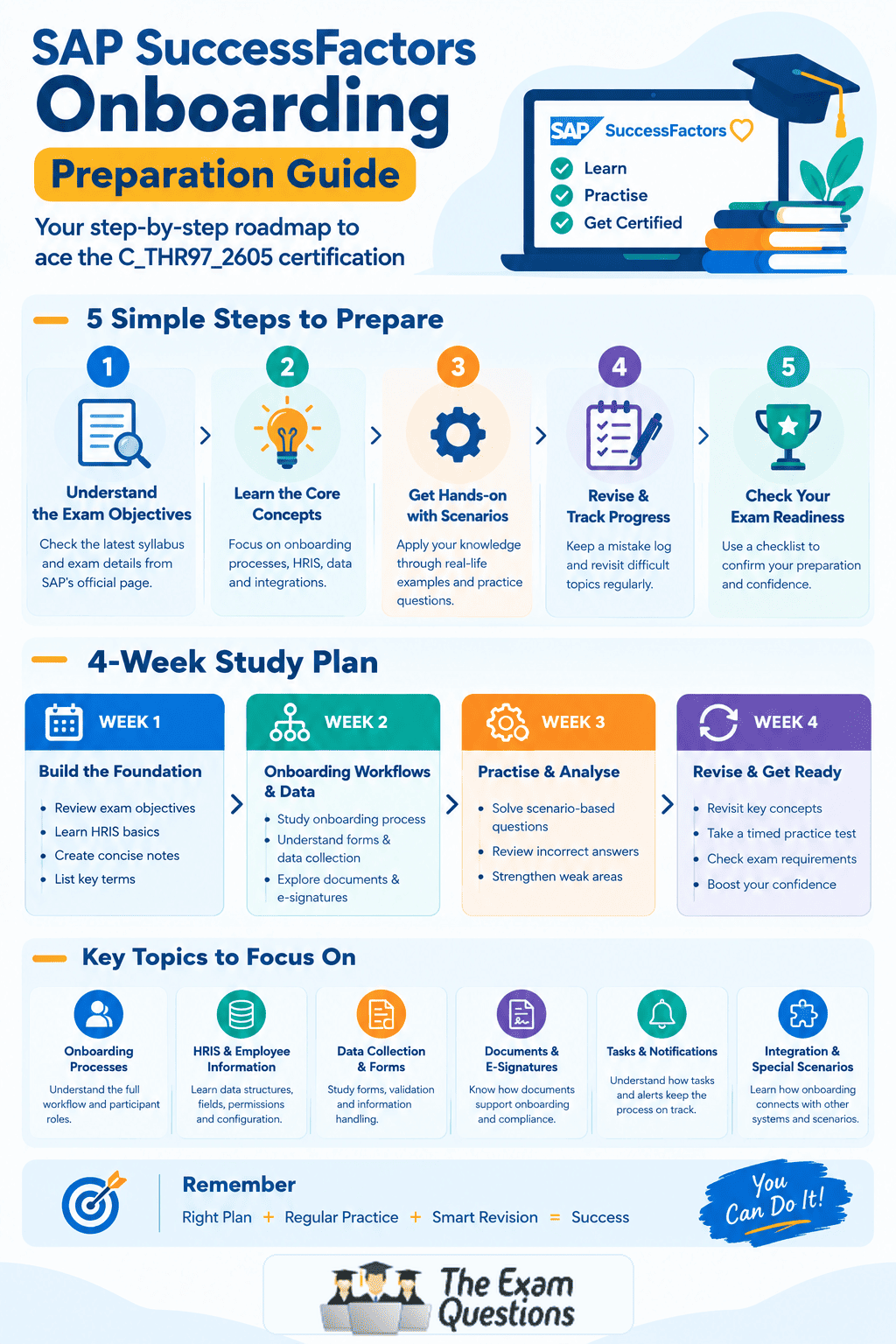
This SAP SuccessFactors Onboarding Preparation Guide gives you a practical roadmap: build a checklist from the official objectives, connect onboarding concepts, revise actively, and learn from your mistakes. It includes a flexible four-week schedule and a readiness checklist. Confirm the current exam version and requirements with SAP before you finalize your plan.
Introduction
Onboarding involves several linked activities. HR teams collect employee details, coordinate tasks, manage documents, and make sure required steps happen on time. A well-organized process keeps that work consistent.
SAP SuccessFactors Onboarding supports digital workflows for these activities. For certification, the job is to understand the relevant system concepts and how they serve real business processes. Jumping between unrelated topics gets you nowhere, so work through the official exam objectives, connect related ideas, and test yourself regularly. This SAP SuccessFactors Onboarding Preparation Guide shows one way to do that.
How do you prepare for the SAP SuccessFactors Onboarding exam?
Read SAP's current certification information, turn the published objectives into a checklist, study each onboarding concept in connection with the business process it supports, revise actively with examples and practice questions, and review your mistakes. Verify the exam version and requirements with SAP before you book.
Start with the official objectives
Open the SAP official certification page and confirm the current exam version, requirements, and available training. Then organize the objectives into a checklist. For each topic, note how well you understand it and what to do next, using three labels: ready for revision, needs practice, and needs further study. A topic is ready when you can explain it clearly. It needs practice when you recognize it but want more examples. It needs further study when it is unfamiliar or you cannot say how it works. The labels help you spend time where it counts and give you a progress measure that does not depend on practice-test scores.
Main onboarding concepts
Onboarding workflows come first. Review the stages, the responsibilities of participants, and how individual tasks lead to completion. Draw a workflow diagram from the first activity through the major steps, noting the information or actions needed at each stage, and then explain it aloud in your own words. If you cannot say why a step exists, go back to the material.
HRIS and employee information give context for records and related HR processes. Study the data structures, fields, permissions, and configuration concepts in your official material, and focus on how accurate information supports onboarding and why proper access matters. Try a case where employee details are incomplete: what would you check, and how would the gap affect the workflow?
Data collection and forms supply what onboarding needs. Review forms, validation concepts, and how information is handled. Consider an incomplete form, an incorrect detail, or a request for more information before a task can proceed. For each, name the issue, the relevant process, and the expected outcome. That practice builds application, not recall.
Documents and electronic signatures come next. Understand how documents support onboarding requirements and where e-signatures fit. Watch how document completion relates to assigned tasks and workflow progress, and confirm system behavior for your exam version in official material.
Tasks, notifications, and coordination tie participants together. Ask who must act, what must be completed, and how the result affects the process. Keep the link between each activity and the wider business objective in view.
Integration and special scenarios round out the list. Review the integration concepts and hiring scenarios in the current objectives, understand the business reason behind each, and see how the process changes with the situation. Not every onboarding case follows one workflow, so read each scenario closely and match its requirements to what you have studied.
Revise actively
Rereading the same notes does not prove you understand them. Active revision tests you. For each major topic, explain the concept without your notes, apply it to an example or practice question, check your answer against reliable material, and write down what you got wrong so you can revisit it later.
Keep notes short. Include the purpose of the concept, its key relationships, a practical example, and the points you keep forgetting.
A flexible four-week schedule
Week one builds the foundation. Review the objectives, study HRIS and onboarding basics, make your checklist, and write concise notes.
Week two connects workflows and information. Focus on processes, employee information, forms, documents, and other syllabus topics, using diagrams to link the stages.
Week three applies your knowledge. Complete practice exercises and scenario questions, review wrong answers, revisit the concepts behind them, and spend extra time on anything unclear.
Week four is revision and readiness. Review difficult topics, test yourself, and run a practice session under reasonable time limits. Confirm the latest certification requirements before the exam.
This is a starting point, not a fixed rule. Stretch it if you need more time with the platform or its configuration concepts.
Learn from practice questions
Practice questions reveal gaps, but the explanations carry the value. When you miss one, resist memorizing the right option. Work out what the question tested and why your reasoning did not fit the situation.
Keep a simple log with four entries per mistake: the topic tested, what you misunderstood, the correct reasoning, and the next concept to review. Over time the log shows which topics deserve the most attention. Treat practice material as support for official preparation, and remember that third-party questions cannot guarantee the content or outcome of the real exam.
Problems to avoid
Studying without a plan makes progress hard to track, so organize sessions around the official objectives. Memorizing terms in isolation leaves you stuck on unfamiliar scenarios, so learn how concepts relate to workflows and requirements. Ignoring weak areas until the last days is risky, so review them regularly with practical examples.
Using too many sources creates confusion, so pick a small set of reliable material and stay with it. Forgetting to verify current requirements is the final trap, because certification details change and old notes can mislead.
Exam readiness checklist
Before your exam, ask whether you can explain the main onboarding workflow in your own words, whether you understand the employee information and data collection concepts, and whether you can connect tasks, documents, and workflow stages. Ask too whether you can explain the reasoning behind your answers to practice scenarios, whether you have reviewed your mistakes and revisited hard topics, and whether you have checked the latest official requirements. Use the answers to find the final areas needing attention. A gap does not mean restarting the whole syllabus.
Frequently asked questions
How should I begin preparing?
Start with SAP's current certification information. Build a checklist from the published objectives and organize your sessions around those topics.
How long should I study?
It depends on your SAP knowledge, HR familiarity, and available hours. A four-week schedule is a useful start, but you may need more or less time.
Should I rely only on practice questions?
No. Combine them with official material, concept review, and practical exercises, and review the reasoning behind answers instead of memorizing them.
Where can I verify the latest exam information?
On SAP's official certification page, which lists current requirements and available training.
Conclusion
A practical preparation plan helps you understand the syllabus, connect key concepts, and make steady progress. Start with the official objectives, study the workflows and employee information concepts, and use practice questions to find gaps. Review mistakes regularly and adjust your schedule as your understanding grows. For more exam-focused content, visit The Exam Questions and compare it with SAP's current official details.