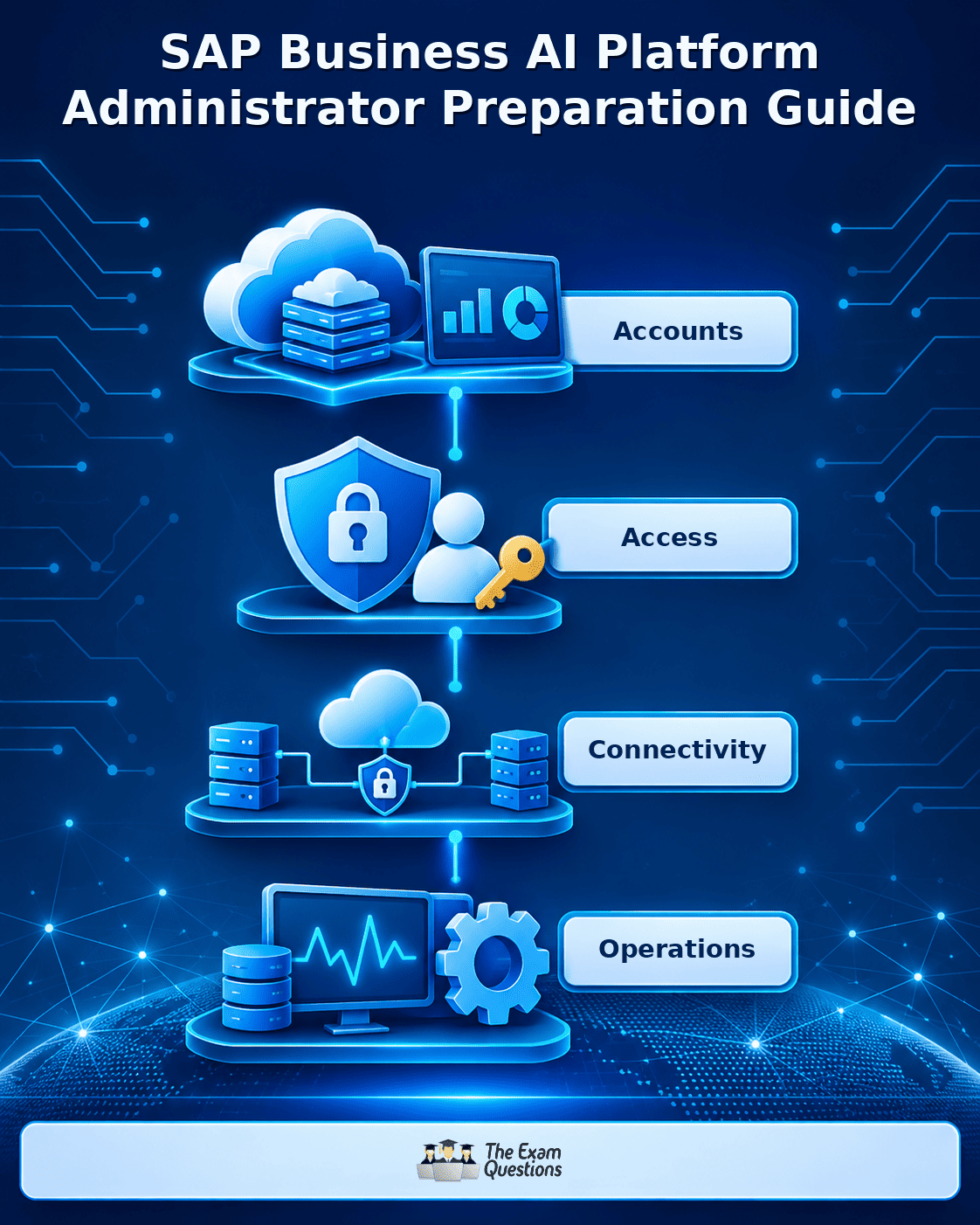
Quick summary
This SAP Business AI Platform Administrator Preparation Guide builds practical readiness for the C_ADBTP system-based assessment. It organizes revision around administrative competencies, a six-step verification habit, a self-built mock assessment, and time management for the two-hour exam. Confirm the current exam details with SAP before you book.
Introduction
The SAP Business AI Platform Administrator certification calls for practical understanding of SAP Business Technology Platform (SAP BTP). Administrators manage accounts, configure services, control access, keep connections working, and monitor operations.
Understanding a concept and performing the task are different skills. You might grasp role collections and still assign permissions wrongly in the BTP cockpit. You might know what a destination is and still miss a bad connection setting. This SAP Business AI Platform Administrator Preparation Guide takes a practical approach to that gap. It shows how to organize revision, practice common operations, and judge whether your skills are ready for the assessment.
How do you get ready for the C_ADBTP assessment?
Organize revision around administrative tasks you can perform, practice each one in an authorized environment, and verify every change by inspecting the result. Build a small mock assessment from representative tasks, complete it without copied instructions, and practice reading the whole task before you act.
Know what you are preparing for
SAP offers SAP Certified - SAP Business AI Platform Administrator under the code C_ADBTP. The official page currently shows a system-based assessment, one activity, a two-hour duration, a displayed pass score of 100%, and English as the language. The assessment evaluates whether you can complete practical activities in an SAP environment, so you must understand the requested work and produce the expected results.
That changes your preparation. Memorized definitions are not enough, and you should know the interface, the administrative settings, the configuration procedures, and the ways to verify a change. Check the SAP official certification page and your own account before you schedule. Assessment instructions, technical requirements, and exam conditions outrank older preparation material.
Build revision around competencies
Instead of treating each subject as a reading exercise, organize your work around what you should be able to do.
Account structure and administration come first. Review global accounts, directories, subaccounts, regions, entitlements, and quotas. Identify the levels of the hierarchy, where subaccounts are created and managed, where entitlements and quotas live, how services are assigned to subaccounts, and how account organization relates to resource allocation. A good exercise is inspecting a sample structure and explaining why an organization might keep separate subaccounts for development, testing, and production.
Identity and security configuration need a clear grasp of authentication and authorization. Review users, identity providers, role templates, roles, and role collections, plus SAP Cloud Identity Services and how identity configuration supports access management. Practice three things: how a user is identified and authenticated, how permissions arrive through roles and role collections, and whether the intended user can reach the required application or function. Be able to explain how the components work together.
Runtime and service administration cover Cloud Foundry and Kyma and their basic administration concepts, along with service instances, plans, subscriptions, and how applications relate to platform services. Practice navigating environment settings and finding the dependencies an application needs. The goal is to tell whether a problem comes from the runtime, service availability, or a wrong configuration.
Connectivity and infrastructure matter when BTP applications talk to external or on-premise systems. Study destinations, connectivity services, authentication configurations, and SAP Cloud Connector. Terraform is another subject in the administrator curriculum, so understand infrastructure as code and become familiar with providers, resources, variables, and configuration files. See how administrators use these tools to keep environments consistent.
Monitoring and operational management cover observability, logs, metrics, alerts, availability, and disaster recovery. Know what each monitoring method shows and how administrators use it to investigate problems. Review consumption and cost management too, including why administrators watch resource allocation and how entitlements and quotas affect service usage.
Use a verification method
The most useful habit in practical preparation is verifying every change. Finishing an action does not prove you got the intended result. Work through six steps. Read the task and identify the expected outcome. Find the right account, service, user, or environment setting. Inspect the current state before you change anything. Apply only the changes the task requires. Verify that the expected configuration or behavior is visible. Then note what worked and what you would investigate if the result were wrong.
When you practice a role assignment, for example, do not stop after assigning a role collection. Check that the intended user has the expected access. Apply the same principle to service configuration and connectivity.
Build your own mock assessment
A personal mock assessment exposes problems before the real exam. In a suitable practice environment, assemble a small set of representative tasks across the main areas. Inspect the account hierarchy to identify its levels. Review entitlements and quotas to understand service availability. Inspect user permissions and verify the access configuration. Explore runtime settings, review a destination and its connection properties, inspect a Terraform configuration for resources and variables, examine sample operational data, and review resource consumption for usage considerations.
Complete the tasks without copied instructions. Use official documentation when you must, but do not lean on it for every navigation step. The aim is to feel at home in the administrative interface and understand why each action is needed.
Manage your time
The certification page shows a two-hour duration, so use it well. Read the complete activity before you change anything, identify the expected outcome, and decide which parts of the platform matter. Avoid exploring unrelated settings, since unnecessary navigation and repeated changes eat time. Prioritize the required configuration, verify the result after each part, and review the final outcome before submission. With one system-based activity, understanding the whole task and its expected result counts for a great deal.
Common mistakes
Relying only on theoretical notes is one. Reading definitions does not build the confidence that completing tasks does. Ignoring account-level differences is another, since some configurations live at the global account level and others belong to individual subaccounts, so always identify the correct level.
Changing too many settings at once makes troubleshooting hard, so inspect the current configuration and adjust in a controlled way. Skipping result verification is risky, because clicking an option does not mean the task worked. Using outdated assessment information is the last mistake, as older C_ADBTP pages may show different details. Verify everything with SAP.
Final readiness check
Before you attempt the certification, test whether you can do these things on your own: explain the BTP account hierarchy, find where entitlements and quotas are managed, understand subscriptions and instances, and review users, roles, and role collections. Also check that you understand identity provider configuration, Cloud Foundry and Kyma concepts, destinations and Cloud Connector, basic Terraform components, monitoring and alerts, high availability and disaster recovery, and consumption and cost management. Finally, you should be able to complete and verify representative administration activities. Mark a topic done only when you can explain it and demonstrate it through a practical task.
Frequently asked questions
How much time should I spend preparing?
It depends on your BTP experience. SAP's Operating SAP Business AI Platform course has about 17 hours and 39 minutes of content across nine units, and you should add time for practical exercises and revision.
Should I practice with the BTP cockpit?
Yes. Familiarity with the cockpit helps you find administrative settings, understand account structures, and work with platform services.
How can I find my weak areas?
Use practical exercises and the readiness check. Notice tasks that need repeated help, wrong configuration changes, or extra investigation.
Conclusion
Preparation for this certification takes both technical understanding and practical administration skill. Be comfortable with BTP account structures, identity management, services, connectivity, infrastructure configuration, monitoring, and cost management. Use this guide as a framework: build your own mock assessments, verify every configuration change, and aim to complete administrative activities on your own. For more exam-focused content, visit The Exam Questions.