Quick Summary
Preparation for SAP SuccessFactors Compensation spans basic plan configuration through complex implementation decisions. Progressive practice, from core concepts to integrated scenarios, builds technical knowledge and the reasoning needed for unfamiliar compensation situations.
Introduction
Some candidates study many questions and still hesitate when a situation involves incorrect budget figures or employee eligibility problems, because they know what a worksheet does and have rarely practiced investigating one that misbehaves. Definitions gain power once they connect with practical requirements, so effective C_THR86_2605 Exam Questions practice moves through levels: fundamental concepts first, configuration decisions next, and situations that link several system processes last. This workbook follows four levels, each with original questions, expected answers, and the reasoning behind them, followed by a framework for measuring your readiness.
The assessment at a glance
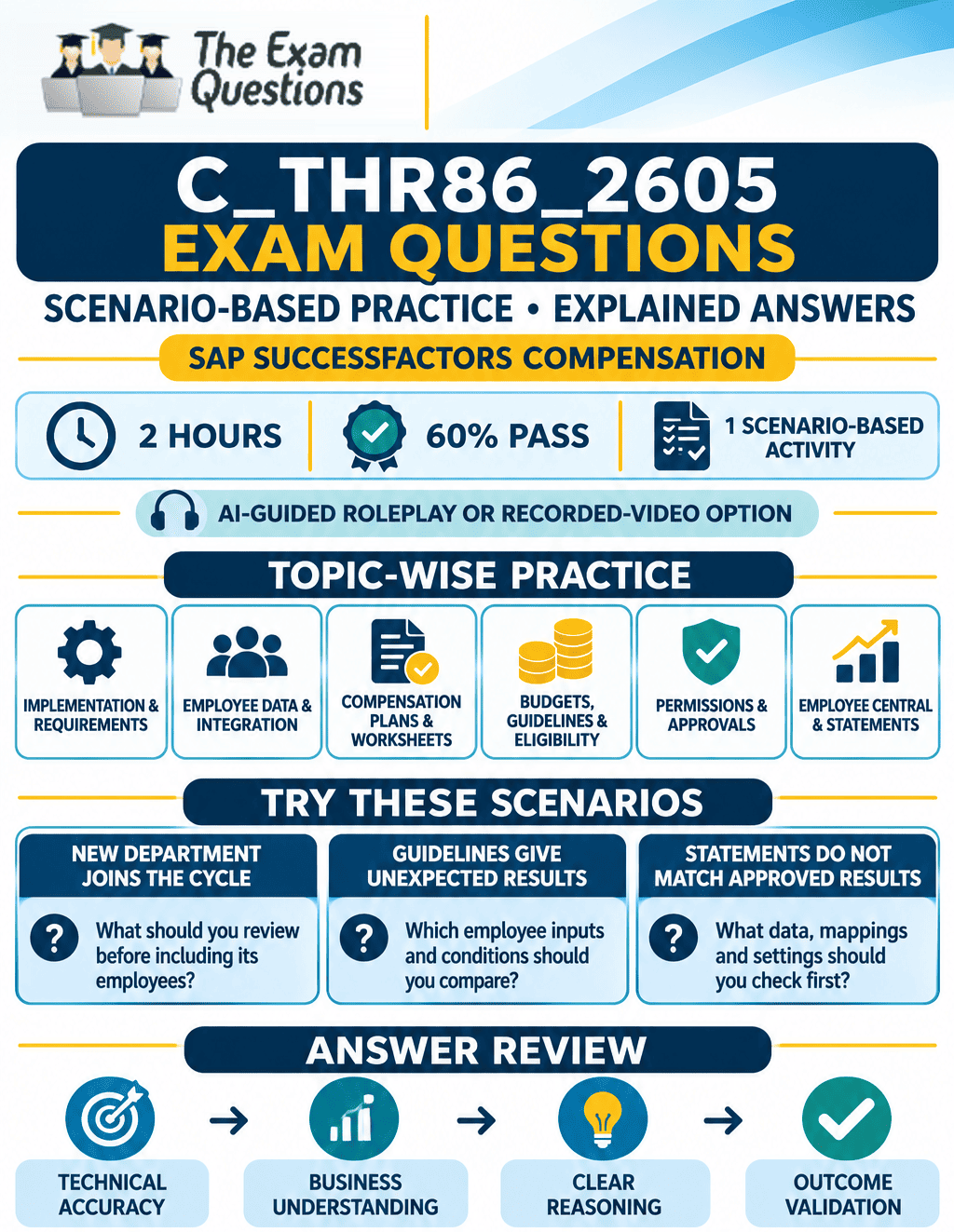
C_THR86 is the SAP certification code for SAP SuccessFactors Compensation, and the 2605 suffix appears in version-specific preparation searches and study material. SAP currently lists a scenario-based assessment with one activity, a two-hour duration, and a 60% passing score. Candidates choose an AI-guided roleplay or a recorded video evaluated by an SAP assessor. The AI assessment weighs the meaning and relevance of responses against expert-defined criteria, and each objective earns a grade from 1 (Insufficient) to 5 (Excellent). Understanding the product comes first, and applying it to business situations follows, which is why progressive practice fits this format. The questions below are original study material and differ from actual SAP exam content.
Level one: core compensation knowledge
Question: What is the primary purpose of a compensation plan template?
- A. To establish the structure used for compensation planning
- B. To replace employee employment records
- C. To manage user passwords and permissions
- D. To generate payroll tax calculations
Expected answer: A. The template brings together planning elements such as budgets, guidelines, eligibility rules, worksheets, and other configuration settings.
Question: How do eligibility rules influence participation in a planning cycle?
Expected answer: They determine which employees take part in the overall plan or in particular components, depending on the level where the rules apply. SAP SuccessFactors Compensation supports eligibility conditions at plan, component, and field levels, and knowing the differences helps when you investigate an exclusion.
Question: Why do worksheets matter?
Expected answer: Worksheets give planners a place to review employee information, enter recommendations, and work with the elements configured for the cycle, connecting plan configuration with manager activity.
Level two: configuration understanding
Question: Why does XML structure validation matter when preparing a plan?
Expected answer: The plan structure follows a required format, and validation exposes structural problems before further configuration. Reviewing the XML and its DTD helps administrators catch issues that could stop a template from working.
Question: An organization runs a compensation planner hierarchy separate from its normal management hierarchy. Which concept should the consultant investigate?
Expected answer: The Compensation Manager or Second Manager hierarchy. The options include the Standard Suite hierarchy, the Rollup hierarchy, and the Compensation Manager hierarchy, and the right choice depends on how planning responsibility is assigned.
Question: What matters when integrating templates with Employee Central?
Expected answer: Review the mapping between template fields and Employee Central fields, relevant employee information, salary range mapping, and publishing requirements. Good mapping lets employee data feed planning and supports transferring approved results.
Level three: applied problem-solving
Question: An employee import places several employees under the wrong planners. What do you investigate?
Expected response: Review the data file, manager relationships, planner assignments, and the hierarchy method configured for the plan. Compare affected employees with correctly assigned ones and look at recent organizational changes.
Assessment focus: data integration and planner hierarchies.
Question: Some recommendations fall outside the expected guidelines. What should be checked?
Expected response: Review the guideline conditions, salary information, performance-related inputs, and employee groups, and compare affected recommendations with correctly calculated examples before changing configuration.
Assessment focus: guidelines and calculations.
Question: A manager cannot move a worksheet to the next approval stage. How do you approach it?
Expected response: Check the worksheet status, route-map roles, permissions, mandatory fields, and validation requirements, and decide whether access configuration or the workflow itself creates the issue.
Assessment focus: permissions, route maps, and worksheet behavior.
Level four: integrated implementation challenges
Challenge: a new cycle with several problems
During testing for the annual cycle, the team finds that some employees are missing from worksheets, departmental budgets differ from approved amounts, and certain managers cannot submit recommendations.
Question: How does the consultant organize the investigation?
Expected response: Separate the issues and name the configuration area behind each one. For missing employees, review employee data and eligibility conditions. For budget differences, examine allocation settings, populations, and calculations. For submission problems, inspect worksheet status, route maps, and permissions. Test each correction on representative employee and manager records before approving the planning launch.
Why it is advanced: it asks you to distinguish three problems in place of applying one general change.
Challenge: approved results differ from employee records
A cycle completes approval, yet salary information in Employee Central misses the expected changes, and compensation statements also show discrepancies.
Question: How do you investigate the complete process?
Expected response: Compare approved results with Employee Central data, then review publishing status, field mappings, effective dates, and processing errors. Compare the approved information with the statements to see whether statement configuration or source data causes the gap. After identifying the cause, test a correction with representative records and verify the resulting employee information before confirming completion.
Why it is advanced: it combines approval, integration, employee data, and statement validation.
How to evaluate your performance
| Skill area | What strong performance looks like |
|---|---|
| Core knowledge | You explain compensation features accurately |
| Configuration | You identify relevant settings and dependencies |
| Problem-solving | You investigate the cause before recommending changes |
| Implementation | You connect several configuration areas |
| Communication | You explain decisions in a structured way |
Look past the count of correct answers and check whether you can explain your reasoning. A candidate who understands why an eligibility condition affects worksheet participation handles unfamiliar situations better than one who memorized a single eligibility question. Review the SAP official certification page for current assessment details and the AI-powered practice tool.
Frequently asked questions
What should preparation questions cover?
Useful practice spans fundamental concepts, configuration interpretation, and realistic implementation situations.
How many difficulty levels should a routine include?
A structured routine works well with four levels: core knowledge, configuration understanding, applied problem-solving, and integrated implementation challenges.
Are these questions actual SAP content?
These questions are original educational exercises, separate from SAP's own exam content.
Does the assessment include AI-guided roleplay?
SAP offers AI-guided roleplay as an assessment option, and candidates may choose recorded-video evaluation by an SAP assessor instead.
Which subjects come before advanced scenarios?
Review plans, XML configuration, employee data, planner hierarchies, eligibility, budgets, guidelines, route maps, Employee Central integration, and statements.
How can candidates find weak areas?
Review incomplete explanations, decide whether product knowledge, configuration understanding, investigation, or communication needs work, and repeat exercises for that skill.
Conclusion
Practice grows more effective as the exercises grow in complexity. Start with the purpose of compensation features, move to configuration decisions, and finish with situations that span several implementation areas. This path builds a stronger understanding of SAP SuccessFactors Compensation and makes it easier to explain decisions under unfamiliar business requirements. For more SAP certification practice, visit The Exam Questions.